October 8, 2026
Can AI take over quality assurance in system implementations?
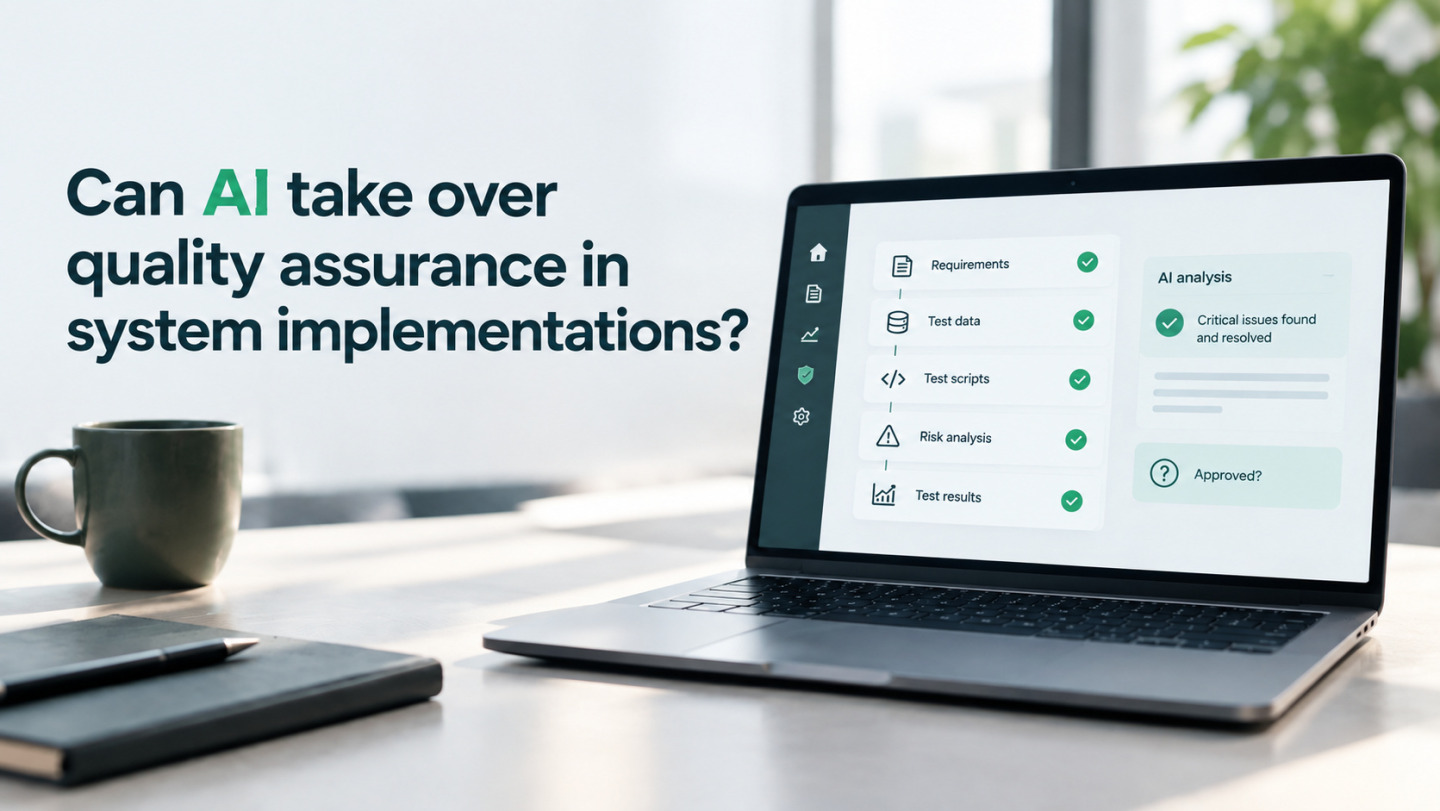
AI already takes over many repetitive tasks in quality assurance. It can review requirements, create test data and test scripts, and suggest which tests to run once the system is live. But AI does not understand your organisation and cannot judge whether a requirement solves the right business problem. Nor can it take responsibility if something goes wrong after go-live. That is why you need to own the test strategy and the final sign-off within your own organisation. AI provides the evidence, but you make the call.
AI makes quality assurance faster across the entire system lifecycle. It can analyse requirements specifications, generate test data and monitor the system once it is live. But there are three things AI cannot take over:
1. It cannot judge whether a requirement solves the right business problem.
2. It cannot take responsibility if something goes wrong.
3. Regulations require someone to stand behind the sign-off. That is why you need to own the test strategy and the final sign-off within your own organisation.
New AI tools can analyse requirements, create test cases and predict risks in code. That is why many leadership teams and project owners are asking: can AI take over quality assurance in a system implementation, from the first requirement to ongoing maintenance?
The short answer is no. AI makes quality work faster and takes over many of the tasks that used to take the most time, such as writing test cases and preparing test data. But someone still has to decide whether the requirements are right, whether the testing is sufficient and whether the system is ready to go live. That decision, and the responsibility that comes with it, stays with a person.
AI takes over the repetitive tasks
AI is most useful as fast support that handles repetitive tasks:
Requirements phase: AI can review requirements documents, flag unclear or conflicting requirements and suggest testable criteria. This means you find errors before the supplier starts building.
Test phase: AI generates test data and test scripts. With what is known as self-healing, test scripts adapt automatically when the user interface changes. This reduces maintenance, but the changes still need to be reviewed.
Maintenance phase: AI monitors logs and user behaviour to detect anomalies. It can also suggest which tests need to be run before the next update.
Three reasons why you need to own the process
1. AI does not understand your organisation
An AI tool can check that a requirement is logically structured. But it cannot judge whether the requirement solves the right business problem. If the underlying requirement is wrong, AI simply builds on that mistake. AI can also invent test steps that do not exist or miss obvious edge cases. Translating your organisation’s needs into the right requirements takes dialogue and domain knowledge.
2. Responsibility cannot be handed over to a tool
Regulations in finance, healthcare and the public sector do not prohibit AI in testing. But they do require you to show who approved what, and on what basis. In the financial sector, for example, DORA makes senior management responsible for ICT risk. An AI report may show that everything is green. If the system then fails in live operation, the algorithm is not the one held accountable.
3. Lock-in lies in your data
Almost every test tool has AI features today. The risk is not the AI itself but where your data ends up. If your requirements, test cases and test history exist only in one tool and cannot be exported, switching becomes expensive. That is why you need to keep ownership of requirements work, test strategy and domain knowledge in-house.
The tester’s role is shifting from doing to reviewing
AI not taking over means the role changes. The focus moves from running tests manually to directing and reviewing what AI produces:
In the project: Check that the requirements are right, remove invented test steps and make sure the tests cover the business-critical processes.
In maintenance: Set thresholds and use signals from live operation to prioritise the right tests for each release.
AI provides the evidence, and the business signs off
AI makes it possible to improve the quality of requirements, automate testing and gain better control once the system is live. But quality assurance is not about producing automated reports. It is about making sure the system supports day-to-day operations, both now and over time. That responsibility has to rest with a person.
Read more
Find out which parts of testing still need a person, and why automation falls short there.
FAQ
Can AI carry out acceptance testing before go-live?
No. Acceptance testing is about the business confirming for itself that the system works in day-to-day use. AI can help prepare test cases and test data, but the sign-off must come from the people who will use the system.
Who is responsible if an AI-generated test misses a defect?
Your organisation. Responsibility lies with whoever approved the test results, not with the tool or the provider of the AI feature.
Is it safe to let AI read your requirements documents?
It depends on the tool. Check where the data is processed, whether it is used to train the AI model and whether the processing complies with GDPR. Requirements documents often contain sensitive information about your organisation.
Share article
Try Reqtest Yourself
Fill out the form to test Reqtest for 10 days. You’ll be sent an email with instructions on how to activate your account.
-
Structure your tests, requirements and bugs
-
Delegate tasks and collaborate with suppliers or project members
-
Follow the progress and get approval before Go-Live
Trusted by Industry Leaders