October 15, 2026
Should you choose a system-specific test tool or a cross-system testing platform?
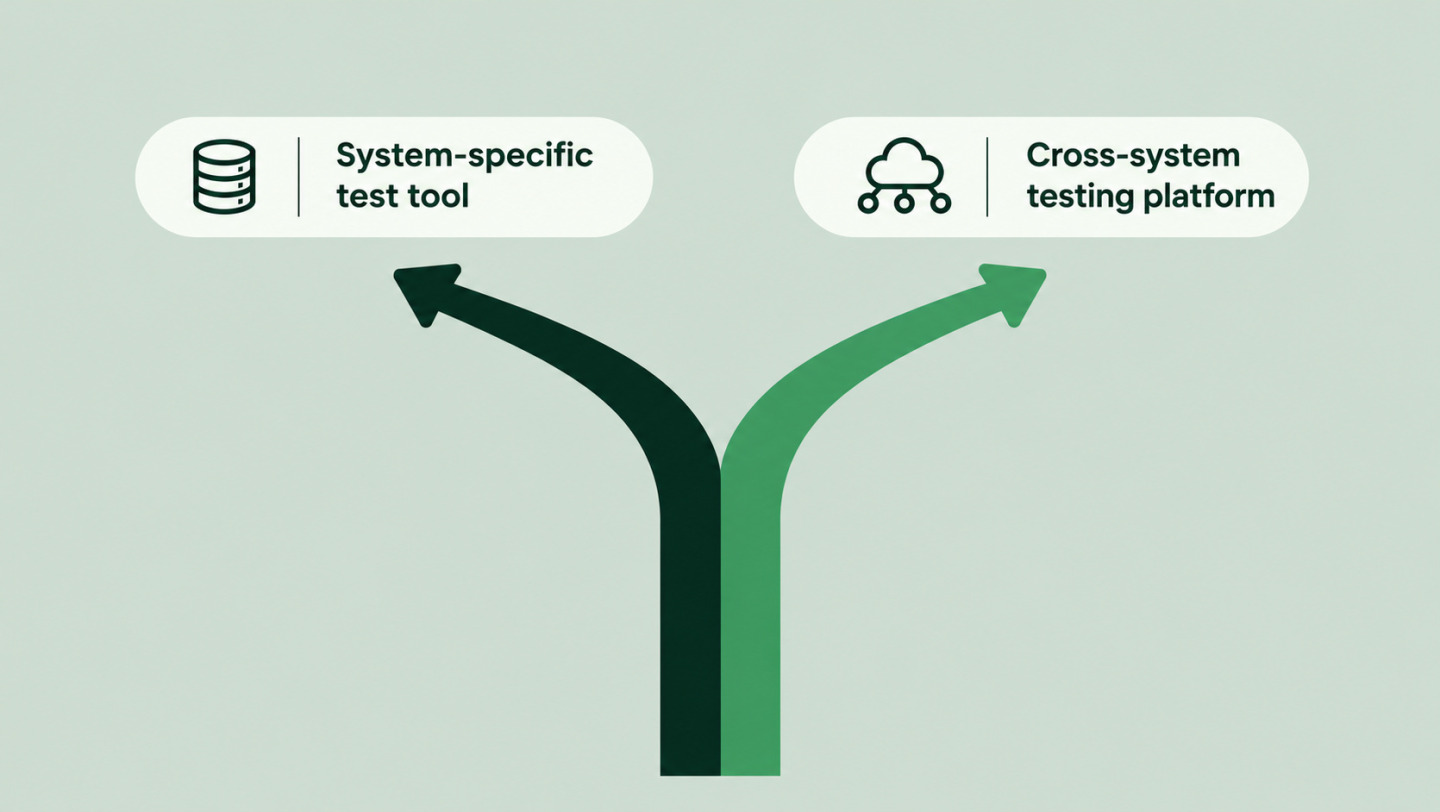
System-specific test tools work well for limited efforts in individual systems. But the risks grow when your organisation runs several projects in parallel, has processes that cross system boundaries or is subject to audit requirements. Test evidence ends up in silos, the chain of evidence develops gaps, and control over your quality documentation sits with the supplier instead of with you.
When a new business system, EAM or HR system is being implemented, it is tempting to use the test tool that comes with the supplier’s ecosystem. It feels convenient at the start and solves the immediate need in the project. But as the IT landscape grows, management and those responsible for testing face a strategic choice.
The question is not only which tool works best technically. It is about how scalable your processes are, who owns the evidence that your systems work, and whether the documentation holds up over time, regardless of supplier.
What is a system-specific test tool?
A system-specific test tool or ALM tool is built to quality-assure a single application, for example an ERP system such as SAP, a CRM or an HR and payroll system. It often comes with the supplier’s own environment.
These tools have real strengths. They are closely linked to the system’s process models and can provide good support when the supplier releases updates. The limitation is that they are built for the supplier’s world, and few larger organisations live in just one system.
When is a system-specific tool enough?
Before you choose a tool to quality-assure a project, you need to ask yourself a few questions. How many systems and projects will be tested, now and in the coming years? Do your business processes cross system boundaries? Are you subject to audit or regulatory requirements that call for traceability and evidence over time? If you recognise your organisation in the points below, the supplier’s tool is often enough.
The project is limited in scope
One system, a small number of people, and new projects are rare.
The flows stay within the system
Information is created and used in the same application.
The requirements for long-term traceability are low
You do not need to show test evidence to an auditor several years from now.
When is a system-specific tool not the right fit?
As the IT landscape grows and systems become connected, the demands on testing change. In the following situations, a system-specific tool often does not go all the way.
1. You run several projects and want a common methodology
In larger organisations, several system and IT projects run at the same time. If each system is tested in the supplier’s own tool, each project ends up with its own ways of working, its own reporting and its own terminology. Instead of building on what already exists, every new project starts from scratch. With a common platform for requirements and tests, the organisation can use the same process and methodology in every project, regardless of system.
2. Your processes cross system boundaries
A process such as order-to-cash can pass through ERP, CRM, e-commerce and an integration layer. Each system may work on its own, but errors often occur in the handover between them. A system-specific tool tests its own part well but does not see the whole chain.
3. You have audit and long-term traceability requirements
When the same supplier delivers both the system and the tool that is meant to show it works, the division of responsibility becomes less clear. An auditor assessing the control environment may then ask how independent the evidence is. Auditors also want to be able to follow the chain from requirement to test, deviation and approval. If the chain runs across several systems but documentation only exists for some of them, gaps appear.
In regulated industries such as life sciences, finance and energy, test evidence often has to be kept for many years. You then need to know what happens to the history if the licensing model changes, the contract expires or the tool is replaced.
4. Your development organisation works in other tools, such as Jira
Built-in tools usually integrate best within their own ecosystem. Connections to tools such as Jira often exist in some form, but they can be limited, one-directional or require middleware. Fields and statuses do not always map one to one. This creates a risk that deviations are logged in two places and that the development and test teams see different pictures. The integrations also need to be maintained when the supplier upgrades its interfaces.
5. You want to avoid supplier lock-in
Test cases, automations and knowledge built in the supplier’s platform are difficult to take with you. This affects your negotiating position and the cost of a future system change. Features, pricing and life cycle follow the supplier’s plans. Each new tool also adds another licensing model and another interface to administer.
Decision support: weigh the pros and cons against your reality
| Factor | Choose an cross-system testing platform if |
|---|---|
| Audit and traceability | Auditors and regulators require an unbroken chain of evidence. |
| Data ownership | Test evidence must be owned by you, independent of supplier contracts. |
| Issue management | Development works in Jira or other tools that need to stay in sync. |
| Resources and roles | Testers, consultants and business experts need to work together. |
| Long-term perspective | Test cases and requirements will be maintained and reused for several years. |
| Reporting | Management requires a complete picture of the total business risk before go-live. |
From one-off effort to scalable strategy
System-specific test tools are good at what they are built for: testing a specific module in a limited project. But for organizations that run several projects, have processes that cross system boundaries or face audit requirements, they quickly become a bottleneck.
By bringing requirements, manual test cases and automated results together in a common, supplier-independent platform, you keep ownership of your quality evidence. The structure works regardless of which system you implement next.
Related articles
Frequently asked questions
How does starting with a system-specific tool affect our ability to scale?
Scalability often becomes locked in. When the next project starts in a different system, the test structure has to be built from scratch again, instead of reusing templates, methods and requirement links.
Do we need our own test tool if the supplier already has one?
Yes, if your processes run through several systems or if you have audit requirements. The supplier’s tool tests its own system well. But end-to-end flows and independent test evidence require results to be gathered in one place that you own.
What happens to our test history if we change system or supplier?
It depends on the contract and the tool’s export options. Find out which format the history can be exported in and whether traceability between requirements, tests and deviations is preserved.
How often do you need to test a cloud-based business system?
Every time the supplier releases an update. Cloud systems are updated several times a year. Automated regression tests of your most important processes make this manageable.
Share article
Try Reqtest Yourself
Fill out the form to test Reqtest for 10 days. You’ll be sent an email with instructions on how to activate your account.
-
Structure your tests, requirements and bugs
-
Delegate tasks and collaborate with suppliers or project members
-
Follow the progress and get approval before Go-Live
Trusted by Industry Leaders