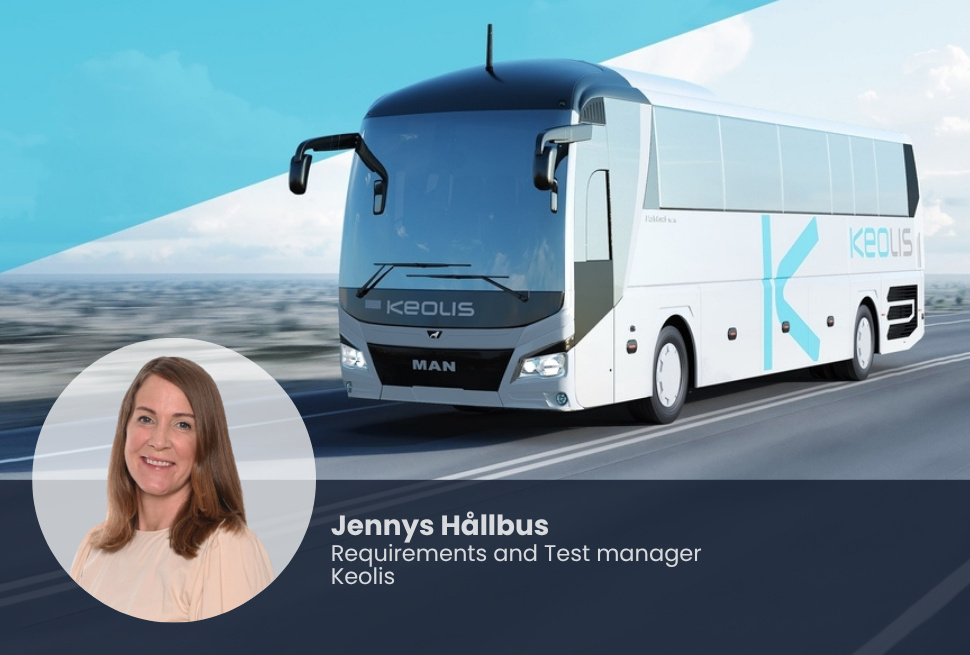
Keolis: Successful EAM Project and a New Framework for Quality Assurance
When Keolis Sweden decided to replace its asset management system — used for maintaining vehicles such as buses — the change affected 14 depots across the country. Jenny Hållbus, requirements and test manager, was given the task of ensuring quality throughout the project. By introducing Reqtest as a support tool, she brought structure to the testing work, reduced administration, and built a framework now reused across new projects.
Key outcomes:
- The pilot depot went live on schedule and without major issues
- A shared framework for requirements and testing was established
- Less administration freed up more time for what matters — testing
- The steering group gained continuous visibility into test status, coverage, and identified defects
- The structure built in Reqtest is reused directly when new projects kick off
Background
Keolis is one of Europe’s largest public transport operators, with around 5,000 employees in Sweden — the majority of whom are bus drivers. As part of its digitalisation efforts, Keolis decided to replace its existing Enterprise Asset Management system, EAM, across all bus depots in Sweden.
Shortly before the system replacement, Jenny Hållbus was brought on as requirements and test manager, having previously worked with Keolis as a consultant. At that point, the company had no shared structure for how testing was carried out.
— When I started as a consultant, there was no dedicated test resource in place — external resources were brought in as needed. For that reason, there was no consistent structure in the testing work either, says Jenny.
Reqtest Was Evaluated in a Pilot Depot
Rolling out the new EAM system across all 14 depots at once carried too much risk. Keolis chose instead to start with a single pilot depot and follow with a gradual rollout. Alongside the system implementation, the team wanted to evaluate whether a shared tool for requirements and test cases could make it easier for the business to participate in testing and give the steering group ongoing visibility into the project.
— The implementation consultants we worked with had good experience with Reqtest, so we decided to try the tool in the project. It gave me the opportunity to evaluate how a dedicated system could support us — a pilot within the pilot, you could say, says Jenny.
Traceability from Requirements to Test Cases
When Jenny joined the project, the requirements were already defined. To ensure strong test coverage, she built a structure in Reqtest linking each requirement to corresponding test cases. During the test phase, super users — people with in-depth knowledge of the system — were brought in to test within their areas of expertise and report results directly in Reqtest.
— It worked really well to put Reqtest in the hands of end users and get exactly what you need from them as a test manager, says Jenny.
The structured handling of requirements and test cases gave the team clear control over what had been tested, what remained, and which defects needed resolving before go-live. Towards the end of the project, an integration was also set up so that defect reports created in Reqtest automatically generated a ticket in Jira for follow-up.
Successful Go-Live and Proactive Maintenance Planning
Thanks to the clear processes and structured way of working, the pilot depot went live on schedule.
— We wanted as smooth a transition as possible to the new system, with minimal disruption to operations — and that’s what we achieved, says Jenny.
Beyond a successful go-live, Jenny was keen to ensure a smooth handover into maintenance. During the project itself, she flagged test cases for critical business processes so they could be reused during monthly system updates.
— I wanted to think longer term — not just focus on getting the system into production. The system doesn’t stop evolving once you go live; there will always be changes and upgrades that need to be managed, says Jenny.
“We’ve been able to spend more time on what actually makes a difference — testing.”
Jenny Hållbus
Keolis
The Result: Less Administration, More Time for Testing
With the pilot complete, it was clear the approach held up. Moving away from Word documents and Excel files to a shared system freed up time that had previously gone to administration.
— It’s been a huge help to have a dedicated tool for our testing instead of fumbling around with Word or Excel documents. We’ve been able to spend more time on what actually creates value — testing, says Jenny.
The reporting functionality in Reqtest also brought a clear sense of confidence to the project. Jenny could quickly show the steering group how far testing had progressed, how many defects had been found, and what test coverage had been achieved against the requirements.
— It created a great sense of reassurance — not just for me, but for other stakeholders too. Being able to give a snapshot of where things stood was very much appreciated, says Jenny.
Faster Ramp-Up in New Projects
The structure Jenny built during the EAM project turned out to have value well beyond that single initiative. When a new project started within Keolis, she was able to reuse the framework from Reqtest and have a new project ready — complete with test structure and templates — within just a few hours.
— It was incredibly straightforward to set up a structure for a new project in just a few hours, says Jenny.
What started as a pilot in a single depot has become a shared way of working — a framework that Keolis now carries into every new project.

Jenny’s Five Lessons Learned
- Think long-term from the start — not just within the scope of the individual project.
- Make sure requirements are testable, clearly documented, and agreed upon by all stakeholders.
- Make it easy for the business to test and follow up on results.
- Take advantage of the tool’s flexibility — there’s plenty of room to tailor it to the specific project.
- Start thinking about the maintenance phase early — not in the final stretch once the system is already in production.
Try Reqtest Yourself
Fill out the form to test Reqtest for 10 days. You’ll be sent an email with instructions on how to activate your account.
-
Structure your tests, requirements and bugs
-
Delegate tasks and collaborate with suppliers or project members
-
Follow the progress and get approval before Go-Live